

Testosterone replacement therapy costs in California depend on 2 main factors. The first is the treatment method, such as injections, gels, oral capsules, or pellets. The second is the care model, which includes lab testing, follow-up visits, and access to a clinician. Many articles only mention the cost of the medication, which can feel reassuring at first. But for many patients, that number does not reflect the full picture. When testing, monitoring, and visits are added, the total cost can be much higher than expected.
We know how stressful and confusing this can be. When you are already dealing with symptoms and trying to feel better, unexpected expenses can create anxiety and hesitation. You deserve clear information so you can make decisions with confidence and without surprises. That is why we want to walk you through the real costs in a transparent and supportive way.
In this article, we share what testosterone replacement therapy costs actually look like when everything is included. We explain how pricing differs by treatment type, why first-year costs are often higher than ongoing care, how insurance and self-pay options compare, and how location and style of care, including concierge programs, can influence your total monthly expense. Our goal is to help you feel informed, prepared, and supported as you explore whether TRT is right for you.
Key findings
- The most affordable TRT option, month to month, usually comes from testosterone injections, while pellets and oral options often land higher once you include procedures and monitoring.
- Your first 90 days typically cost more than later months, since you pay for diagnostics and early dose tuning.
- TRT cost with insurance can drop medication expenses, yet you may still pay out of pocket for labs and follow-ups.
- TRT cost without insurance varies widely by pharmacy, dosage, and how your clinic bundles visits and labs.
- In Southern California, pricing can shift by county and city, mostly due to visit pricing, lab pricing, and whether care happens in person, at home, or via telehealth.
Methodology of Our Research
We built this article to show you the most realistic total, not the best-case medication price. To make sure the information in this guide is reliable and realistic, we carefully reviewed pricing that is publicly shared by a range of providers. This included national telehealth TRT programs, in-person urology and hormone clinics, and concierge practices across Southern California. These sources outline not only medication pricing, but also procedure fees, lab testing, and monitoring requirements.
Here’s how we’ll present numbers in the pricing sections that follow:
- We separate total cost into medication, clinician access, labs, and procedure fees when relevant (like pellets).
- We use simple tables with one number per column and no dollar signs for quick comparison.
- Under each table, we add bullets that explain real-world ranges with dollar signs, plus what drives the gap.
- We include the Southern California context and show how Orange County, Los Angeles, and nearby areas can price differently.
Testosterone Replacement Therapy Costs by Treatment Type
The treatment method you choose plays the biggest role in how much you pay month to month. Each option delivers testosterone differently, which affects medication pricing, how often you need follow-ups, and whether procedures are involved. This section compares the most common TRT options to show how costs stack up beyond the prescription alone.
Average Monthly TRT Costs by Type
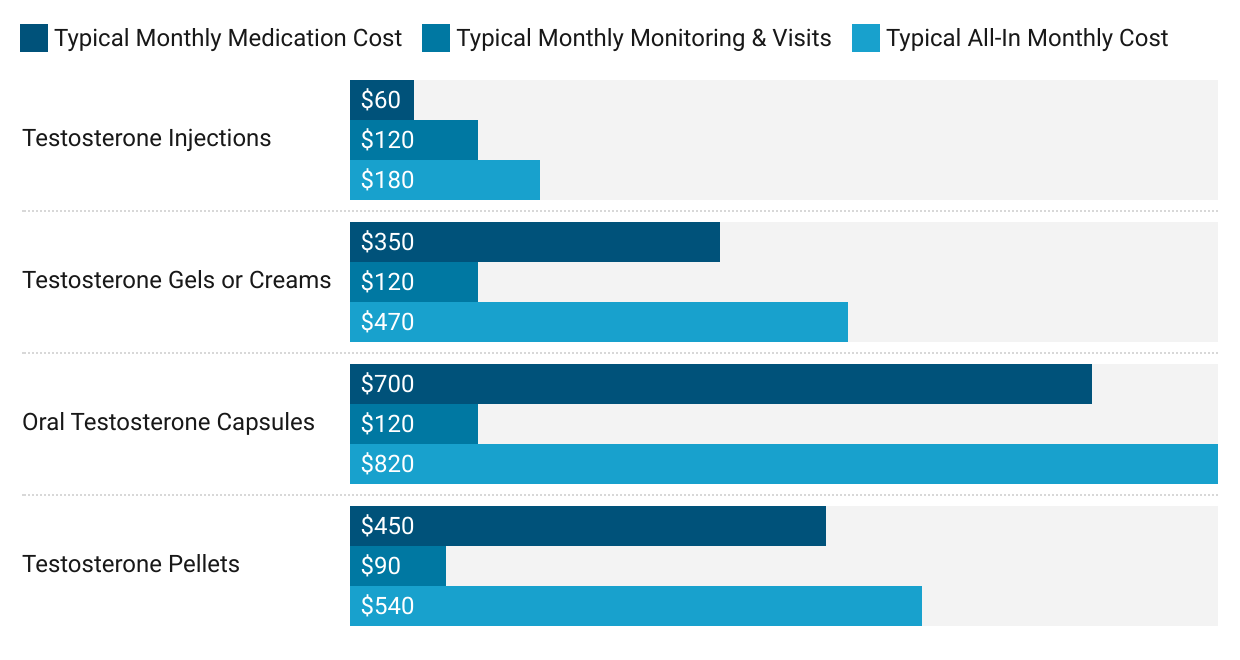
- Testosterone injections in CA usually cost between $20–$100 per month for medication, depending on dose and pharmacy. They often come with regular check-ins early on, which is why monitoring still matters even with lower drug costs.
- Testosterone gel and cream costs commonly fall in the $200–$500 per month range. These options avoid needles but tend to carry higher pharmacy pricing and daily use requirements.
- Oral testosterone therapy often runs $400–$1,000 per month. Convenience drives demand here, though absorption and ongoing labs can push totals higher.
- Testosterone pellet costs are usually billed per procedure, often $1,000–$2,000 every 4–6 months. The monthly figure above spreads the cost over time, which helps with comparison, but does not reflect how clinics bill upfront.
What pushes costs up or down
- Dosage adjustments during the first few months
- How often are labs repeated while levels stabilize
- Whether visits are in person, virtual, or in-home
- Pharmacy sourcing and compounding fees
- Procedure fees for pellet placement
Testosterone Replacement Therapy Costs in Southern California
Location affects TRT pricing more than most people expect. Even with the same treatment type, costs can shift based on how visits are delivered, how labs are priced, and whether care is bundled into a program or billed piece by piece. Southern California also has a wider pricing spread than many regions due to demand, travel time, and care models.
This section shows how testosterone replacement therapy costs typically compare across major Southern California areas when you include visits and monitoring, not just medication.
Typical Monthly TRT Costs by Southern California Area
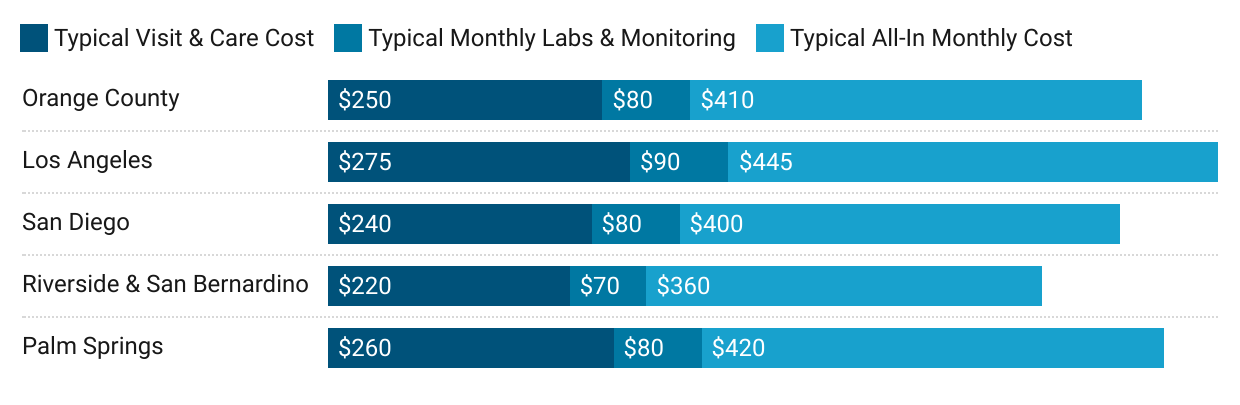
- Orange County and Los Angeles often land higher due to visit pricing, clinician availability, and demand for in-home or same-day care. Monthly totals commonly fall between $400–$500 once labs and follow-ups are included.
- San Diego pricing tends to sit slightly lower than Los Angeles, especially when care is delivered through scheduled clinic visits rather than house calls.
- Riverside and San Bernardino usually come in lower, often $350–$400 per month, driven by lower visit costs and fewer procedure premiums.
- Palm Springs pricing can climb when travel time or limited provider availability factors in, even though lab costs stay similar to coastal markets.
Why city pricing varies
- In-person versus telehealth visit mix
- Use of house calls or concierge access
- Lab partnerships and testing frequency
- Pellet procedure pricing when applicable
- How clinics bundle monitoring into monthly plans
First-Year vs Ongoing Testosterone Replacement Therapy Costs
One reason testosterone replacement therapy costs feel unpredictable is that pricing changes over time. Your first year almost always costs more than later years. That is not a pricing trick. It reflects how TRT is prescribed and monitored in real clinical settings.
Early on, your care team needs more data. Once your levels stabilize, costs usually flatten out.
Typical TRT Costs: Year One vs Maintenance Years
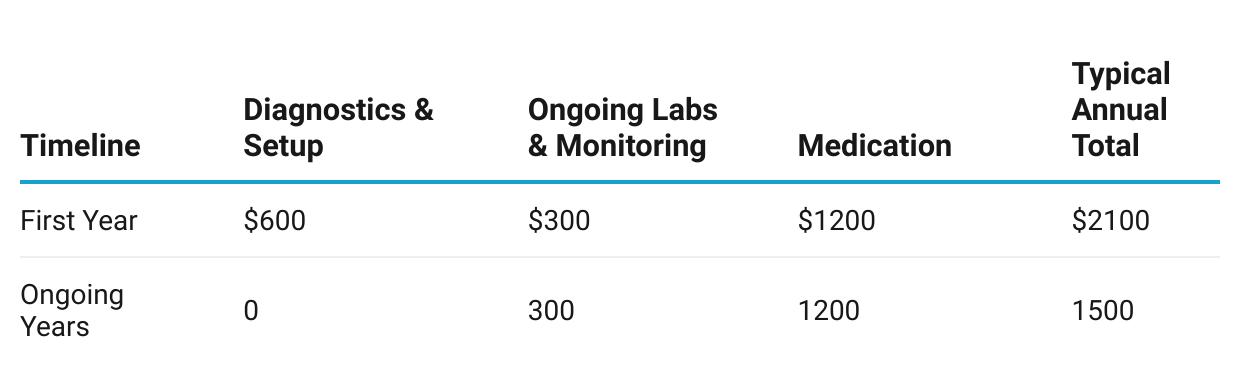
- Initial lab work often includes total testosterone, free testosterone, estradiol, SHBG, PSA, and blood counts, which can add $400–$800 in the first few months.
- Early treatment usually involves more frequent check-ins while dosage and delivery method are adjusted.
- Some patients try one therapy type, then switch methods, which can temporarily increase costs.
What changes after your protocol stabilizes
- Lab frequency typically drops to quarterly or semiannual testing, which keeps annual monitoring closer to $250–$400.
- Medication costs tend to stay consistent unless your dose changes.
- Visits become more predictable, especially when care access is bundled rather than billed per appointment.
Factors That Influence Testosterone Replacement Therapy Costs in CA
Even within the same treatment type, two people can end up with very different TRT bills. That happens because testosterone replacement therapy costs respond to clinical decisions, not flat pricing. This section explains what actually moves your monthly total up or down.
Treatment Type and Dosage
Your dosage has a direct effect on medication cost. Higher weekly or biweekly doses increase pharmacy pricing, regardless of whether you use injections, gels, oral capsules, or pellets.
- Injection dosing changes can shift monthly medication costs by $20–$60.
- Gel and cream dosing adjustments often move costs by $50–$150 per month.
- Pellet dosing affects how many pellets are inserted, which raises procedure pricing rather than monthly billing.
Monitoring Frequency and Lab Panels
TRT is not a set-and-forget treatment. Labs guide safety and dose accuracy, especially early on.
- First-year monitoring usually includes more frequent bloodwork, which raises short-term costs.
- Maintenance phases typically require fewer panels, which lowers annual totals.
- Expanded panels that include metabolic or cardiovascular markers increase lab spend but provide broader health insight.
Visit Style and Access Model
How you see your provider matters as much as how often.
- Pay-per-visit clinics charge each appointment separately, which can inflate costs during dose optimization.
- Telehealth-only models reduce visit pricing but may still require outside lab coordination.
- Concierge and membership-ased care bundles access, which smooths out monthly expenses.
Insurance Coverage vs Cash Pay
TRT cost with insurance can reduce medication pricing, but it rarely eliminates all expenses.
- Many plans still require copays for visits and labs.
- Coverage varies by formulation, with injections more commonly covered than gels or oral options.
- TRT cost without insurance depends heavily on how care is packaged and whether labs and visits are included.
Location and Provider Structure
Geography affects pricing through visit costs, lab contracts, and care delivery.
- Urban Southern California markets often price higher due to demand and travel time.
- Clinics offering in-home visits factor travel and scheduling into pricing.
- Multi-location providers can keep pricing more consistent across counties.
Final Thoughts
Testosterone replacement therapy costs make the most sense when you look at the full picture. Medication matters, but it is only one part of what you actually pay. Labs, follow-ups, visit style, and how care is structured usually drive the bigger swings, especially in your first year.
If you only compare starting medication prices, you miss the costs that show up a few months later. If you only compare monthly memberships, you may overlook what is included and what is billed separately. The goal is not to find the lowest advertised number, but to understand what your care will realistically cost once treatment is underway.
UnifyCare bundles physician access, follow-ups, and coordination into a single monthly structure, which makes testosterone replacement therapy costs easier to plan for, especially during the first few months of optimization. Medication and lab pricing can still vary based on dosage, treatment type, and testing cadence. The difference is that your care access does not fluctuate month to month.
Sources
American Urological Association. (2024). Evaluation and Management of Testosterone Deficiency. [https://www.auanet.org/guidelines-and-quality/guidelines/testosterone-deficiency-guideline]
Figueiredo MA, et al. (2021). *Testosterone Therapy With Subcutaneous Injections: A Safe, Practical, and Reasonable Option*. [https://pubmed.ncbi.nlm.nih.gov/34698352/]
GoodRx. (n.d.). *Depo-Testosterone prices, coupons, and savings tips*. [https://www.goodrx.com/depo-testosterone?label_override=depo-testosterone]
GoodRx. (n.d.). *Testosterone Cypionate*. [https://www.goodrx.com/testosterone-cypionate/what-is]
GoodRx. (n.d.). *Testosterone Replacement Medications*. [https://www.goodrx.com/conditions/testosterone-replacement/drugs]